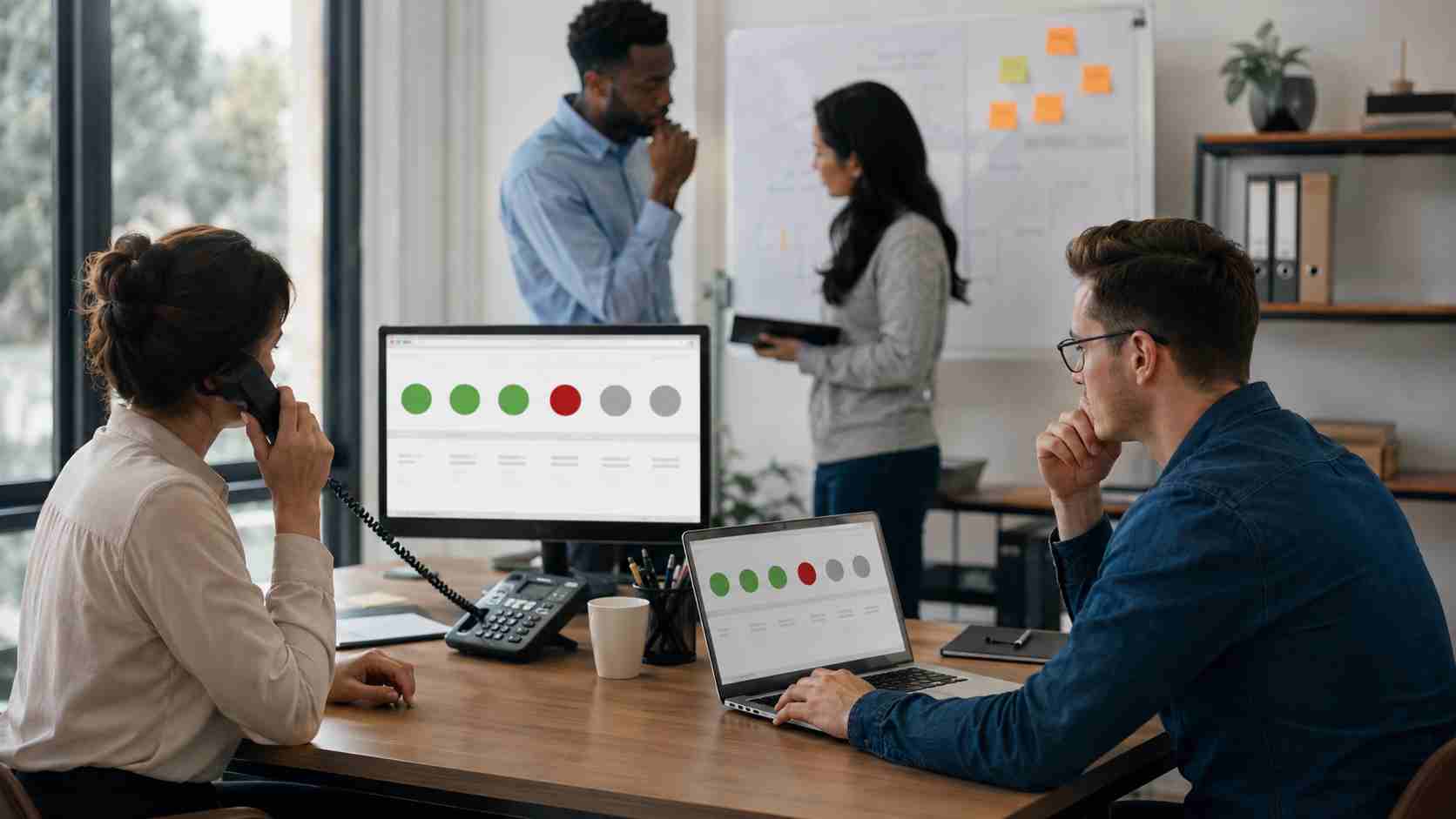
An employee connects a laptop to the docking station, but one monitor stays black. Another person returns from lunch and sees “no signal.” A conference-room screen worked yesterday but is missing today.
These problems are common, and they are especially frustrating because everything appears to be connected.
A failed second screen can slow down accounting, scheduling, design work, customer service, document comparison, and any job where employees rely on several windows at once. Before replacing the monitor or changing advanced Windows settings, use a simple troubleshooting order.
A typical dual-monitor workstation may include:
The fastest way to narrow down the cause is to determine whether the problem follows the monitor, cable, dock port, or computer.
Ask these questions:
These details help support staff avoid replacing the wrong equipment.
Start with the physical basics.
Make sure the monitor’s power light is on. Check the power cable at both the monitor and the outlet. Then press the monitor’s input or source button and confirm it is using the connection actually plugged into it, such as HDMI or DisplayPort.
Next, check the display cable at both ends. A cable can look connected while sitting slightly loose. If the workstation uses a dock, also check the cable between the laptop and dock.
Some laptops have more than one USB-C port, but not every port necessarily supports video or full docking features. Use the port approved for that laptop model.
Avoid repeatedly forcing a connector into place. If a port, plug, or cable looks bent or damaged, stop and report it.
Windows can be connected correctly while displaying the desktop on only one screen.
Press Windows key + P and choose Extend. Extend mode allows the desktop to spread across multiple monitors.
You can also open:
Settings > System > Display
Look for the multiple-display section and select Detect if an expected monitor does not appear.
If Windows sees both monitors but they are arranged incorrectly, use the Identify option. Windows will display a number on each detected screen so they can be placed in the correct left-to-right order.
Randomly unplugging everything makes it difficult to learn what failed. Change one item at a time.
Try this order:
If a different cable fixes the problem, the original cable is likely faulty. If the monitor works when connected directly to the laptop but not through the dock, the dock, dock connection, software, or firmware deserves attention.
Docking stations are small computers in their own right. They may need firmware and software updates to work reliably with laptops and monitors.
Microsoft recommends keeping Windows and device drivers current. Dock manufacturers also publish model-specific firmware and troubleshooting information.
Business users should not download drivers from random websites. Updates should come from Windows Update, the computer manufacturer, the docking-station manufacturer, or the company’s managed IT tools.
If the display stopped working immediately after an update, record the date and what changed. That information can help IT determine whether the problem affects one workstation or several similar devices.
Contact IT support when:
Recurring failures usually point to a compatibility, hardware, cabling, firmware, or standardization problem. Repeating the same five-minute workaround every morning is not a long-term fix.
Businesses can reduce these interruptions by standardizing workstation equipment.
Use approved docks, chargers, and cables for each laptop model. Label shared conference-room connections. Keep a record of dock models and firmware. Replace damaged cables promptly, and avoid mixing power adapters that look similar but provide different capabilities.
Managed IT support can also track recurring incidents. If five employees report the same blank-screen problem, the issue should be treated as one shared equipment or configuration problem rather than five unrelated support tickets.


Himala and his team at Cybernetic Networks have been amazing. We have been a customer of Cybernetic Networks for well over 14 years now, both personally and professionally. Himala and his team are professional, reachable and on the cutting edge of technology. We have enjoyed doing business with Cybernetic Networks for many years and still rely on their knowledge, skills and technology every day
Himala and his Cybernetic team have never let me down! For over 10 years now they have been fixing my technical issues, set up all my new networks and computers and have safeguarded me from any hackers or malware. You can trust this company to navigate you as your company grows and to keep you on track with the latest in security and safety
I am a solo practicing neurologist and have had all my IT needs covered through Cybernetic Networks since 2007. They are the best! All of their tech support staff is extremely knowledgeable and efficient. Just as importantly, they are quickly responsive whenever we need their assistance. I couldn’t be happier with their service and give them my highest recommendation!
I couldn't be happier with Cybernetics - they are experts, always respond quickly , and solves any issues I have.
Cybernetic Networks has been advising and supporting all our IT issues and purchases for the last 18 years. They are very responsive and extremely knowledgeable- always providing us with timely services.
It is not often you find small business companies that are not only rewarding to work with, but also have integrity, truth and skill. I have worked with this company for over 20 years, and the service is outstanding. I can easily recommend that if you need an IT company, this is the one to get. Full STOP! Look no further, you will be happy that you did. Sue Myhelic, Gulf Breeze Real Estate, Naples, Florida.
Himala and his team from Cybernetic Networks, Inc. has been an integral part of our successful retail business for the past 20 years. He is extraordinarily knowledgable and always available for our IT needs. Thanks to Himala and his team we are always up and running.