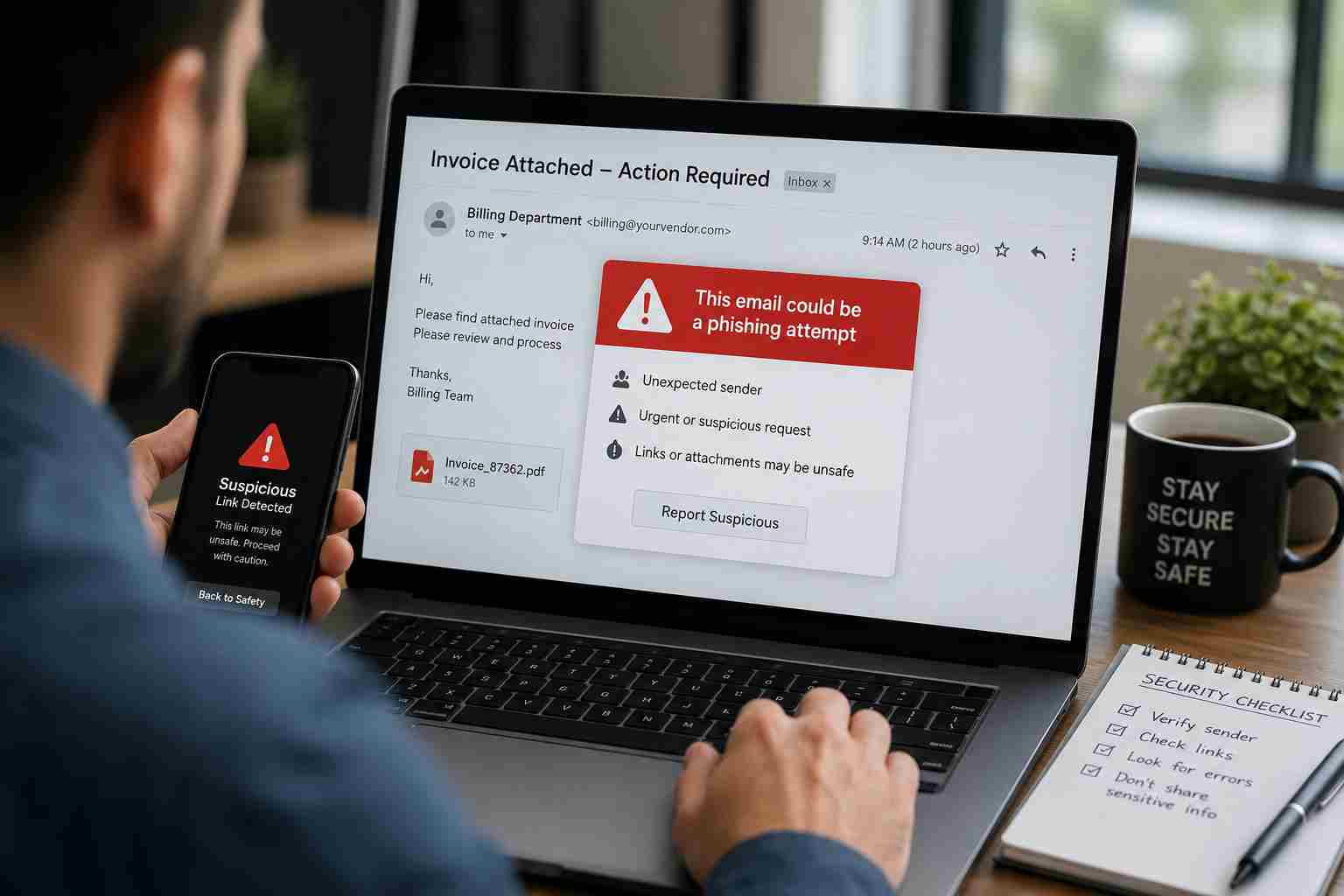
Many business owners think of phishing as a messy email full of spelling mistakes, strange links, and obvious red flags. That still happens, but it is no longer the whole story.
Today’s phishing attempts are often more focused. Instead of sending millions of sloppy messages, attackers may aim at a bookkeeper, office manager, owner, or salesperson with an email that looks like it fits their normal workday.
That is why small businesses should treat phishing as a business risk, not just an IT nuisance.
Recent security reporting shows that phishing activity may be shifting from high-volume blasts toward more targeted attacks. In plain English, criminals are trying harder to make fewer messages work better.
That can mean:
For a small business, one successful phishing email can lead to stolen money, exposed customer data, a locked Microsoft 365 account, or a ransomware incident.
Small businesses often run lean. One person may handle invoices, payroll, scheduling, customer communication, and banking. That makes the business efficient, but it also means a well-timed scam can cause real damage.
A fake payment request sent at the end of a busy Friday can slip through. A fake Microsoft login page can capture an employee password. A compromised email account can be used to message customers, vendors, or staff from a real mailbox.
The impact is not just technical. It can affect cash flow, customer trust, insurance claims, downtime, and the owner’s peace of mind.
Start with payment verification. Any request to change bank details, wiring instructions, or payment method should be confirmed using a known phone number, not the contact information inside the email.
Use multi-factor authentication, but do not stop there. MFA is important, but staff still need to recognize fake login pages, suspicious approval prompts, and unexpected password reset messages.
Make reporting easy. Employees should know who to contact when something feels off. A quick “Can someone check this?” can prevent a costly mistake.
Review email security settings. Microsoft 365 and other email platforms include protections that many businesses never fully configure.
Limit account access. Not every employee needs access to every mailbox, file, admin tool, or payment system.
Train around real scenarios. A short, practical conversation about fake invoices, vendor changes, and login alerts is often more useful than a long technical lecture.
If an employee clicks a suspicious link or enters a password, act quickly.
Change the password, review sign-in activity, check mailbox forwarding rules, look for suspicious sent messages, and confirm whether any financial or customer information was exposed. If money was transferred, contact the bank immediately and report the incident through appropriate channels such as the FBI Internet Crime Complaint Center.
The faster the response, the better the chance of limiting damage.


 Trustindex verifies that the original source of the review is Google.
  Trustindex verifies that the original source of the review is Google.
  Trustindex verifies that the original source of the review is Google.
  Trustindex verifies that the original source of the review is Google.
  Trustindex verifies that the original source of the review is Google.
  Trustindex verifies that the original source of the review is Google.
  Trustindex verifies that the original source of the review is Google.
  Trustindex verifies that the original source of the review is Google.
  Trustindex verifies that the original source of the review is Google.
  Trustindex verifies that the original source of the review is Google.
Himala and his team at Cybernetic Networks have been amazing. We have been a customer of Cybernetic Networks for well over 14 years now, both personally and professionally. Himala and his team are professional, reachable and on the cutting edge of technology. We have enjoyed doing business with Cybernetic Networks for many years and still rely on their knowledge, skills and technology every day
Himala and his Cybernetic team have never let me down! For over 10 years now they have been fixing my technical issues, set up all my new networks and computers and have safeguarded me from any hackers or malware. You can trust this company to navigate you as your company grows and to keep you on track with the latest in security and safety
I am a solo practicing neurologist and have had all my IT needs covered through Cybernetic Networks since 2007. They are the best! All of their tech support staff is extremely knowledgeable and efficient. Just as importantly, they are quickly responsive whenever we need their assistance. I couldn’t be happier with their service and give them my highest recommendation!
I couldn't be happier with Cybernetics - they are experts, always respond quickly , and solves any issues I have.
Cybernetic Networks has been advising and supporting all our IT issues and purchases for the last 18 years. They are very responsive and extremely knowledgeable- always providing us with timely services.
It is not often you find small business companies that are not only rewarding to work with, but also have integrity, truth and skill. I have worked with this company for over 20 years, and the service is outstanding. I can easily recommend that if you need an IT company, this is the one to get. Full STOP! Look no further, you will be happy that you did. Sue Myhelic, Gulf Breeze Real Estate, Naples, Florida.
Himala and his team from Cybernetic Networks, Inc. has been an integral part of our successful retail business for the past 20 years. He is extraordinarily knowledgable and always available for our IT needs. Thanks to Himala and his team we are always up and running.