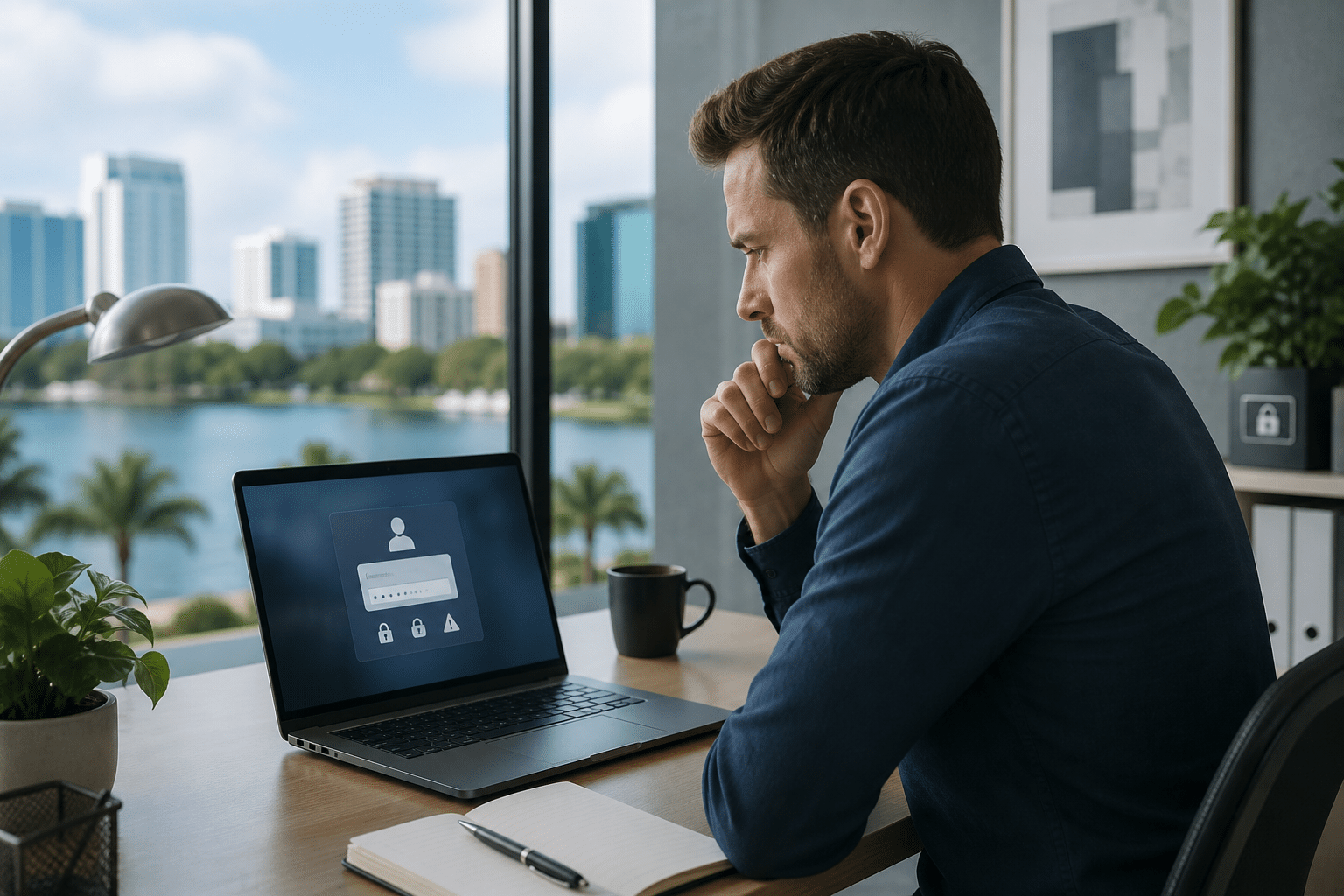
For years, businesses were told to turn on multi-factor authentication, or MFA, to make accounts safer. That advice is still directionally right, but the threat has changed.
In April 2026, Microsoft described a widespread phishing campaign that used a legitimate device login process in a deceptive way. Instead of simply stealing a password, attackers tricked people into approving access to the attacker’s session. Microsoft also said the campaign used automation and AI-assisted tactics to make the scam more effective and more believable.
In plain English: some phishing attacks are no longer trying to “break” security the old-fashioned way. They are trying to talk employees into opening the door for them.
This is a real small-business issue, not just an enterprise headline.
Attackers are using bait that seems like everyday office things: invoices, proposal requests, shared files, password alerts, voicemail notices, and account updates. For a busy office manager, bookkeeper, contractor, medical practice coordinator, or retail administrator, those messages can look routine. That is exactly why the risk is growing.
If one staff member accepts a wrong login, a criminal could enter email, files, chats with customers, and private financial talks. From there, the damage can spread quickly.
A successful account takeover can lead to:
For many small businesses in Orlando and nearby areas, email works like a front desk, a filing cabinet, and a payment system all at once. If email is compromised, operations can become disorganized very quickly.
Traditional MFA methods like text codes, emailed one-time codes, and push notifications are becoming less effective against new phishing tricks. That does not mean MFA is useless. It means some forms of MFA are stronger than others.
The objective is phishing-resistant sign-in, usually using passkeys, security keys, or more reliable app-based identity controls that are difficult to deceive.
For a small business owner, the message is clear: if your security still relies primarily on passwords and a text code, you may be safer than in the past, but you are not adequately prepared for the current threat landscape.
You do not need to rebuild everything at once. Start with the basics that reduce risk quickly:
Determine whether your staff primarily relies on passwords along with text-message codes or basic app approvals.
Start with owners, executives, finance staff, HR, and anyone who can approve payments or access sensitive records.
Train employees about "approval scams."
Employees should know that a login request, code entry page, or file-sharing prompt can be part of a phishing attack even if it looks familiar.
Review forwarding rules, suspicious inbox rules, and administrator accounts. These are common places attackers use after they get in.
Switching to stronger sign-in is easiest when it is planned, tested, and explained clearly to staff.
The discussion around cybersecurity for small businesses is evolving from “Do you have MFA?” to “Do you have the appropriate account protection against today’s scams?”
That is an important difference.
At Cybernetic Networks, we help small businesses strengthen email security, tighten Microsoft 365 controls, and roll out practical protections that fit the real pace of business.For companies that do not have an in-house security team, that kind of guidance can make the difference between a close call and a costly incident.
Source Links


 Trustindex verifies that the original source of the review is Google.
  Trustindex verifies that the original source of the review is Google.
  Trustindex verifies that the original source of the review is Google.
  Trustindex verifies that the original source of the review is Google.
  Trustindex verifies that the original source of the review is Google.
  Trustindex verifies that the original source of the review is Google.
  Trustindex verifies that the original source of the review is Google.
  Trustindex verifies that the original source of the review is Google.
  Trustindex verifies that the original source of the review is Google.
  Trustindex verifies that the original source of the review is Google.
Himala and his team at Cybernetic Networks have been amazing. We have been a customer of Cybernetic Networks for well over 14 years now, both personally and professionally. Himala and his team are professional, reachable and on the cutting edge of technology. We have enjoyed doing business with Cybernetic Networks for many years and still rely on their knowledge, skills and technology every day
Himala and his Cybernetic team have never let me down! For over 10 years now they have been fixing my technical issues, set up all my new networks and computers and have safeguarded me from any hackers or malware. You can trust this company to navigate you as your company grows and to keep you on track with the latest in security and safety
I am a solo practicing neurologist and have had all my IT needs covered through Cybernetic Networks since 2007. They are the best! All of their tech support staff is extremely knowledgeable and efficient. Just as importantly, they are quickly responsive whenever we need their assistance. I couldn’t be happier with their service and give them my highest recommendation!
I couldn't be happier with Cybernetics - they are experts, always respond quickly , and solves any issues I have.
Cybernetic Networks has been advising and supporting all our IT issues and purchases for the last 18 years. They are very responsive and extremely knowledgeable- always providing us with timely services.
It is not often you find small business companies that are not only rewarding to work with, but also have integrity, truth and skill. I have worked with this company for over 20 years, and the service is outstanding. I can easily recommend that if you need an IT company, this is the one to get. Full STOP! Look no further, you will be happy that you did. Sue Myhelic, Gulf Breeze Real Estate, Naples, Florida.
Himala and his team from Cybernetic Networks, Inc. has been an integral part of our successful retail business for the past 20 years. He is extraordinarily knowledgable and always available for our IT needs. Thanks to Himala and his team we are always up and running.